Tuesday, September 21, 2010

Ethiopian Haile Gebrselassie wins the Great North Run


The Bupa Great North Run, Gateshead:
Coverage: Highlights on BBC Two and online from 2310-2340 BST

Haile Gebrselassie
Gebrselassie wins 'special' Great North Run
Ethiopia's Haile Gebrselassie powered to an emphatic victory in his first Great North Run in Gateshead on Sunday.
The two-time Olympic 10,000m champion was unable to threaten the 2005 course record of 59 minutes 05 seconds.
But the marathon world-record holder, 37, surged clear at halfway to win by a huge margin from Kenya's Kiplimo Kimutai in a time of 59:33.
Fellow Ethiopian Berhane Adere won a tough women's race, with British runner Mara Yamauchi fifth.
Gebrselassie was fulfilling a long-time promise made to race chairman Brendan Foster by taking part in the race.
What is important is to win - the Great North Run is very special
Haile Gebrselassie
In the 30th running of the event, run in cool, overcast conditions, the half marathon world record-holder finished 1:50 ahead of Kimutai with Morocco's Jaouad Gharib third.
"It was wonderful," Gebrselassie told BBC Sport. "I needed someone to keep the pace until the last 2km and maybe then it would have been faster, but I was on my own most of the race.
"What is important is to win - the Great North Run is very special.
"I have been dreaming for many years of racing here. I kept promising that I would come and finally I've made it."
His compatriot Adere, who won the women's race in 2006, pulled clear with two miles remaining and finished in 68:49 to beat Portuguese duo Ana Dulce Felix and Marisa Barros.
Yamauchi, Britain's leading woman runner, was unable to keep up with the pace but was happy with her time of 70:39 as she builds up towards a tilt at November's New York Marathon.
"It was a reasonable time," the 36-year-old told BBC Sport. "I was hoping to go a little bit quicker but hopefully in another month I'll be going quicker."
Andrew Lemoncello was the leading British male, finishing in ninth place in 63:48.
Britain's Paralympic medallists David Weir and Shelly Woods won the men's and women's wheelchair races.
Weir held off Canada's Josh Cassidy, who pipped him to the line in April's London Marathon, to win the event for the fourth time in 44:49 while Woods chalked up her third triumph in 52:59.
Around 54,000 runners took part in the race from Newcastle to South Shields.

Saturday, September 18, 2010

Haile Gebreselassie is like the Becks of running


Brendan Foster with Haile Gebreselassie


HAILE GEBRSELASSIE’S first appearance in the Great North Run will be watched by more than 11 million Ethiopians as the David Beckham of long-distance running finally fulfills a decade-old promise.

Gebrselassie is arguably the greatest long-distance runner of all time and is one of the most famous faces in Ethiopia after winning Olympic goal medals and breaking 26 world records over a variety of distances.

The 37-year-old will finally compete in the Great North Run tomorrow 10 years after he pulled out of the event because of an Achilles injury just a month after he took gold in the 10,000 metres at the Sydney Olympics.

And that will ensure the event celebrates its 30th birthday with its largest ever television audience.

Gebrselassie said: “Running in Ethiopia is like soccer is here in England. The popularity and interest is the same. In Ethiopia, people are always looking for the results of all the big races. The interest over there is crazy.

“I don’t do any training in the city – I do my training outside. When I train, people shout at me and call out my name all the time.


“In the city, it is hard for me to run. Many people recognise me, so it is hard to get on with my work.

“It is probably like being a soccer player in England. I’m not sure if it’s quite the same as being David Beckham, but maybe it’s something like that.”

Gebrselassie intends to return to England in 2012 to run in the Olympic marathon, but he does not even know if he will qualify for the Ethiopia team. That should also serve as a reality check for Britain’s long-distance hope and European champion Mo Farah.

The Ethiopian said: “It is a massive ambition to compete in 2012. I hope I am one of the names there.

“That would mean a lot to me, but it will not be easy. I have to qualify first, and because of all the competition in Ethiopia, it will not be easy.

“To be in the top three in Ethiopia is hard. In many ways, qualifying for the team will be even harder than doing well in London.”


Ethiopia Claims Ever-Larger Role In International Flower Trade


by Staff Reporter, Florint.org Posted: Friday, September 17, 2010 at 11:11AM EDT

Over the past few years the Ethiopian flower export has shown a substantial increase, resulting in many thousands of new job opportunities as well as growing foreign exchange earnings. Flowers have in fact become the second most important Ethiopian export product, rivaled only by the trade in coffee.
Exports as a whole have grown immensely in the horn-of-Africa country, but fresh flowers are certainly taking the cake. The Ethiopians have earned more than 250 million dollars from flower exports in the last ten months alone, according to Agriculture and Rural Development State Minister Aberra Deressa.
That is only the beginning, as far as the Ethiopian government is concerned. Further expansion of the production of flowers, fruits and vegetables for export is in the works. Although Kenya remains the major flower exporter on the continent as it stands, a number of investors have already made the switch to Ethiopia. The financial incentives the government offers play a significant role in that decision, and will likely ensure the continuing growth of the Ethiopian flower industry. A growth that currently significantly outpaces that of rival Kenya already.
To read the rest of this story please go to: Florint.org

Tuesday, September 7, 2010

Ethiopians Prefer Driving Home-grown Cars


E-mailPrintPDF
By Luc van Kemenade NEW BUSINESS ETHIOPIA CONTRIBUTOR
With public purchasing power on the rise, Ethiopia’s small but emerging middle class yearns to cruise around Addis Ababa in style. They refuse to pay sky-high import taxes for second hand cars. Instead, they prefer driving around in home-grown vehicles.

A model by Lifan motors, Former Partner of Holland car plc now its market competitor

The supply of new models assembled in Ethiopia increases and this is reflected in the streets of the capital city. More often the “Ethiopian” cars appear among the chaotic traffic that is still dominated by rundown Lada cabs and Toyota Corollas.

It costs a small fortune to get a second hand vehicle from the West through the port of Djibouti into landlocked Ethiopia. Although taxes have been reduced, they can still rise up to over 100 percent of the purchase value plus the transportation costs, i.e. unaffordable to many. For a twenty years old Toyota Corolla, for example, you pay 12,500 euro.

The solution is simple: import spare parts, from China for example, and assemble them in a factory with relatively cheap labour. Although a simple strategy, it’s quite unique on the African continent. Various investors in Ethiopia saw the opportunity and grabbed it, Holland Car, a Dutch-funded company, being the first.

A model by the Pioneering car assembly in Ethiopia- Holland car plc
Sishah Yohannes, a forty-year-old captain at Ethiopian Airlines, drives his Ethiopian-assembled Holland Car Awash for a month now. “I’m really proud when I see the name written in Amharic on the back,” he says while parking at the Bole Medhane Alem Church. “This is what I’ve been waiting for: a good Ethiopian product after all this talk about economic growth.”

Holland Car’s general manager, Tadesse Tessema, convinced the Ethiopian government to lower import taxes on spare parts, making the business even more attractive. Shortly after, he presented three models, all named after Ethiopian rivers: Abay, Tekeze and Awash. Recently they launched a new family car: Shebele.

Other car assemblers followed suit. First there was competition from Holland Car’s former Chinese partner. Yangfan Motors launched three models of its Lifan Cars in Ethiopia. One of them shows resemblance to Holland Car’s Abay. The two companies split after a dispute and used to produce the model together.

A nice spectacle in the streets of Addis is Lifan’s Mini-Cooper look-a-like, the Lifan 320. The company prefers to describe it in masculine terms as a “mini-SUV with the power of a bear”, but it’s a “typical lady’s car”, according to car salesman Thomas Mulune.

The latest competitor for the passenger’s car market is Hyundai. The South Korean company enters Ethiopia with heavy artillery, Haile Gebreselassie being its ambassador, investor and sole importer. The assembly plant is under construction and personnel are to be trained to assure “international standards”, the successful athlete said.

A model recently assembled by BH Trading and Manufacturing Plc


Satisfied with the competition in the market he initiated, Holland Car CEO Tadesse is preparing for a new step. He’s building a gigantic plant that will be finished in two months. From that day, he will slowly reduce the import of parts and work towards producing full Ethiopian cars.

“As a pilot, I’m can choose between different cars from all over the world,” Sisha says. “But I prefer to encourage guys like Tadesse and Haile by buying Ethiopian ones. If the quality is there, of course.”

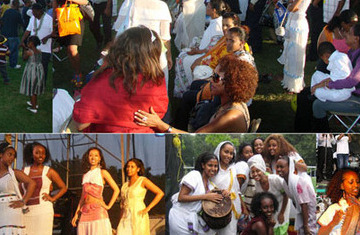
Ethiopian Torontonians Gearing Up For 12th Ethiopian Day Celebration


Above: 12th annual Ethiopian Day Celebration, hosted by the
Ethiopian Association in the GTA- scheduled for this weekend.
Tadias Magazine
Events News
Published: Tuesday, September 7, 2010
New York (Tadias) – Ethiopian Torontonians are gearing up for their city’s 12th annual Ethiopian-Canadian Day Celebration, scheduled to take place this coming weekend at Christie Pits Park in Toronto.
The day long event features a variety of booths, arts, crafts, food and live entertainment – including Ethiopian music, reggae and other African grooves, organizers announced.
The yearly festivities, which also serve as a celebration of enqutatash  (New Year) for the estimated 50,000 Ethiopians in the Greater Toronto Area, is organized by The Ethiopian Association in the GTA and Surrounding Regions. “It is with sense of obligation to preserve and promote our heritage that the Ethiopian Community in Toronto has taken over the task of organizing such an event,” the organization noted on its website following last year’s activities. “As in the past, our Association took charge of planning, budgeting and coordination of tasks.”
“In no other festivity do local Ethiopians’ spirit, talent and culinary skills shine as they do on the annual day-long Ethiopian New Year’s celebration,” wrote Yeamrot Taddese, Tadias Magazine’s contributing reporter from Toronto, in her recent series of articles about the city’s Ethiopian soccer team Ethio Star’s pending bid to host the 2011 tournament hosted by the Ethiopian Sports Federation in North America (ESFNA).
“The event, also dubbed ‘Ethiopian Day,’ is the most anticipated gathering in the community that features live music, rising Ethiopian entrepreneurs, social justice advocates and lots of injera.”
If You Go:
12th annual Ethiopian-Canadian Day Celebration
Saturday, September 11, 2010
10am to 11pm
at Christie Pits Park
Learn more at Ethiocommun.org

IMF Welcomes Devalued Birr

Sukhwinder Singh, IMF representative in Ethiopia.


The International Monetary Fund (IMF) has welcomed last week’s move by Ethiopia’s central bank to devalue the Birr by 16.7pc on Wednesday, September 1, 2010.
The Birr was quoted at a weighted average of 16.3514 against the dollar compared with 13.6284 on Tuesday, August 31, by the National Bank of Ethiopia (NBE). The new rate was confirmed by an NBE official who was not authorised to make further comments.
The IMF welcomes this move given that it will help bolster Ethiopia's competitiveness, Sukhwinder Singh, IMF representative in Ethiopia, told Reuters.
“It will need to be supported by an appropriate monetary policy,” said Singh.
An ambitious five-year economic plan, which aims to achieve average annual economic growth of 14.9pc over the period and to end the Horn of Africa nation's dependence on food aid, was unveiled by the government last month.
Ethiopia is Africa's biggest coffee exporter and the world's fourth largest exporter of sesame. With a population of 80 million, it is also one of Africa's biggest potential markets and most of its people have no telephones or bank accounts.
The devaluation is the country’s fourth since January 2009. Devaluations can spur economic growth and reduce current account deficits to the extent that they boost exports and discourage imports, although they carry the risk of importing inflation.
“I think it is related to the new five-year plan and a strategy of export promotion and import substitution,” Tewodros Mekonnen, an economist with the Ethiopian Economics Association (EEA), a local think-tank, told Reuters. “There is a risk that it could cause inflation but it will probably also boost foreign direct investment and remittances.”
Inflation hit a high of 64.2pc in July 2008. After the peak, the country's central bank instructed private banks to restrict borrowing, the government halted state borrowing and increased bank reserves to drive the rate down. It slowed to 5.7pc in July 2010.
“Years of high inflation have eroded the country's export competitiveness, and the government has continually favoured sharp currency depreciations to counteract this,” Joseph Lake, an analyst at the Economist Intelligence Unit (EIU), told Reuters. “Although inflation has eased in recent months, this pattern of currency depreciation is likely to continue. Low levels of foreign exchange reserves, and twin fiscal and current-account deficits, will continue to put pressure on the Birr.”
Ethiopia, one of the world's biggest recipients of foreign aid, is keen to attract foreign investment in agriculture and mineral exploration. The country has operated a managed floating exchange rate regime since 1992.